Tuesday, 22 February 2022

October, 2021 - Skimming into Sweden

After visiting portions of five countries in 9 days, our intrepid travelers found themselves gliding through Swedish waters, on the very beautiful approach into Stockholm. From the open water of the Baltic Sea, a ship must negotiate a very long channel between dozens of islands on the approach to the capital. From beyond Kapellskar, Sweden to the pier in Stockholm, a ship travels a distance of over a hundred kilometers. It is a very fetching route which reminded Gym of the ferry from Horseshoe Bay to Swartz Bay in British Columbia. All along the Swedish passage there are beautiful waterfront properties but unlike the Canadian ferry route, there are also a number of historic fortifications and some very old estate properties. Gym and his fair bride were ending this cruise with a very memorable stretch of sailing.

It should be pointed out that the MS Marina did visit Karlskrona, Sweden not long after leaving Copenhagen and we will review that stop in this post. However, since we hung around Stockholm for several nights after we disembarked the ship, the bulk of this post will be about that great city.

The cruise started in the kingdom of Denmark and it ended in the kingdom of Sweden. These monarchies are the 7th and 8th oldest monarchies in the world. Both monarchies are over a thousand years old, dating back to the Tenth century. Just like his counterpart in Denmark  (Queen Margrethe), King Gustav of Sweden is ceremonial head of state and his duties are mainly representative in nature but he enjoys strong public support. In terms of area, Sweden is 10 times larger than Denmark but they compare more favorably in terms of population, with Denmark at about 6 million Danes and Sweden at 10 million Swedes. These countries are good friends today but have fought 11 wars with each other since the early 16th Century. All this background is important when you consider what our undaunted travelers saw in these two countries.

Karlskrona 

The M/S Marina left Copenhagen on August 29, 2021 and before going on to visit the Baltic States and Finland, it stopped in the Swedish port city of Karlskrona, on September 1, 2021. Karlskrona has a population of about 65,000 and is actually closer to Copenhagen than it is to Stockholm. It was founded in 1680, as a better place to park the Swedish Navy because it was ice free in winter and ships tended to get stuck in Stockholm. The Swedish Navy could keep a closer eye on Denmark from Karlskrona. The Swedish Navy has been there ever since and today the headquarters of the Swedish Coastguard also resides there.

This is a very much baroque-style city. Baroque is the architectural style of the 17th and 18th centuries and is known for its ornate detail. Gym and his lovely wife would participate in a walking tour of the city and visit many of the baroque buildings that have survived for over 400 years. The city is laid out in a large grid-pattern which makes it easy to find your way around but it is hilly and you are hiking on cobblestones most of the time. We visited the area around the modern naval base, some baroque churches and unfortunately, found a fantastic candy store on the day. The fallout from the expedition into the candy  store undid some of the exercise benefit we had been getting to at that point in the day. The highlight of this tour though was a visit to the Swedish Naval Museum which Mrs. Gym even found fascinating. It was one of the best museums we have ever visited.

Gym continued to observe the blonde and blue-eyed Scandinavians for signs of discontent. The locals seemed generally calm, laid back and friendly.  

Stockholm

Stockholm was the terminus of the 9-day Baltic cruise and the Marina tied up there on September 7th. However, the passengers did not have to disembark right away. They got to stay onboard and enjoy the big floating hotel for another day and night. On that last day, they could finish packing and either polish off the liquor in the room or do an optional half-day tour organized by Oceania. Since the boss had all of the packing under control, she decided to sign up for one of the short tours that was offered. A "Highlights of Stockholm" tour, coupled with a visit to the Vasa Museum, was chosen as the excursion for the day. The unopened liquor was rolled up in Gym's pants and successfully made it home.

The story of the Swedish warship Vasa is fascinating. It was launched in 1628 and after sailing a few hundred meters into the harbor, it floundered. It had disembarked with great fanfare, and after firing a salute, it tipped over and sank, having served the Swedish Navy for less than an hour. The Swedish king who was off warring with Lithuania-Poland at the time, must have been quite shocked when he heard the news. He had dumped a lot of cash into the Vasa. It was intended to be the flagship of the fleet. It turns out that the ship was top-heavy. Who was to blame? Well, maybe it was the king's well-meaning entourage. The king's inner circle spared no expense in decorating the Vasa for their sovereign. Essentially, there was not enough ballast to make up for the elaborate upper decks that were 'built-for-a-king'. It may have also  had something to do with placement of some of the heaviest guns on the upper deck, instead of leaving them on the lower deck. In any event, it must have been quite a scandal at a time when Sweden was just beginning to become a major power in the Baltic Sea.

As incredible as was the story of the short life of the Vasa, the salvaging of the ship from the bottom of the harbor and the ship's restoration are amazing too. The ship was raised almost completely intact in 1961. It had lain there on the bottom of the harbor for 333 years. Then in the 1950s after locating the wreck, they got together and formed the Vasa Board to plan and execute the resurrection of this iconic vessel. Just like in a Clive Cussler novel, the raising involved some hairy stuff. It was very dangerous work for divers that tunneled under the hull of the ship so they were able to run cables through and around the wreck. The ship was slowly floated by securing these lines to two pontoon-barges that were lined up parallel to the Vasa. They then raised the massive hulk, a meter at a time, by filling each barge with water and then pumping the water out and tightening the lines. Once they could float it between the barges, they were actually able to move it over to shore and rest it on cement caissons to give it a base where they could restore it. Then, over the next 2 decades they got to work putting the puzzle back together and drying out the wood. Part of the drying process involved spraying the wreck with ethylene glycol (antifreeze) for 17 years, to dry out the oak and the other hard woods. Then in 1990, after piecing it all together and building an elaborate shell around it, the Vasa Museum was opened to the public. It is the most popular attraction in Sweden and was thoroughly enjoyed by Gym and his dear companion.

After visiting the Vasa Museum, our travelers were given a whirlwind tour of the city in a minivan (the area covered by the following plat). Gym who is not usually directionally-challenged, did not find the tour helpful to orient himself. The fact is, the city is built on 14 islands, connected by some 50 bridges and just when you think you figured out the 'grid pattern', the grid shifts (see below). The most daunting area is the old medieval part of the city adjacent to the Palace, with its very narrow streets. You just need to walk around for a few days to get your bearings.  Luckily, Gym and his dear wife planned to make Stockholm their base camp for the next few days to explore the city and get rid of their sea legs.

See how you might get turned around in Stockholm.  Our travelers
explored almost all of the area which is depicted in this illustration. 

On September 8th,  after a nice breakfast in their stateroom, the intrepid travelers strolled down the gangplank, grabbed their luggage and hailed a taxi. They planned on decompressing in a hotel within walking distance of Stockholm Central Station and spending a few days seeing the sights. They chose their accommodation wisely because the Radisson Blu was right next to the station. 

Between September 8th and September 11th, Gym wore out a pair of Sketchers as he and his lovely companion swore off taxis for 3 days and never once ate in the Radisson. Here are some highlights from their multiple expeditions:

1. Stockholm's Old Town is mostly located on the island of Stadsholmen in the middle of the above illustration. Parts of the Old Town are also located on 2 or 3 of the smaller islands around Stadsholmen. The area is characterized by very narrow, winding streets. Some of the streets are not wide enough for cars and it seemed that most were pedestrian only. It was about a 15-minute walk from Stockholm Central Station.  Our travelers visited the area multiple times over all three days of their stay and enjoyed the very medieval feel of the area with its many small shops and restaurants.  Each time they went to Stadsholmen, they walked down Drottninggatan pedestrian mall and crossed the footbridge that takes you behind the Swedish Parliament and the Royal Palace. This was a very scenic route and avoided crossing busy streets where cars were allowed. 

2. Stockholm's parks are a big part of the city. The Swedes are out walking in their parks every day and so were Gym and his fair bride. Each morning Gym would search the internet for a well-recommended brunch place about a mile or so in a new direction.  After a leisurely brunch, there was always a nearby park to explore and burn off some carbs, helped along by the caffeine enjoyed with their meal. 

3. They looked and talked like Americans but hoped that their Team Canada hats might provide a softer visage in Europe. Notwithstanding the appearance of the travelers, the Swedes were always hospitable and some were to go above and beyond to help with detailed directions on how to find our way through the train station or to recommend the best way to get to Hamburg. It was originally planned on taking the train to Germany but the hotel concierge patiently and diligently worked with our heroes to book plane tickets instead. That was clearly not something that was in his job description but he very kindly moved us in the right direction. Kudos to the Radisson staff and every server in every restaurant visited. Gym was often surprised by the ease with which the locals switched into their flawless and unaccented versions of the English language at every turn. 

Including the one-day stop in Karlskrona, our travelers spent just 4 days in Sweden. There are innumerable palaces, churches and museums that were missed.  So little time...

Following is a series of pictorial accounts of the Swedish experience:

KARLSKRONA


The defenders of Karlskrona welcomed the intrepid travelers.

Bastion Aurora, just part of the defensive fortifications protecting the town.


In front of the Admiralty Church is the figure of Rosenbom.  
If you lift his hat, you can insert a coin for the poor.

Admiralty Bell Tower

The Karlskrona Stortorget is the largest town square in Sweden. It is 
located on the highest point of the town and is flanked by numerous baroque
buildings.


Pathway leading to the underground bunkers
below the town.

Fredrik Church from the middle of the square.

Look at all that candy!


The Marin Museum dedicated to the preservation of Sweden's naval history.

Don't touch those Gym!

Carved wooden figureheads from old sailing ships.

The coolest exhibit that surprises the patron, is an exhibit
containing two real Swedish naval submarines.


On the left is the HMS Hajen (Shark) that served from 1905-1922. It had a crew of 8.  It is a rare 
example of a sub from that era. On the right is the HMS Neptun (Neptune) that served 
from 1980-1998. It had a crew of 22.

A view from the rear of the Neptune shows the massive exhibition hall that 
was built to hold the two submarines.


STOCKHOLM


Cruising into Stockholm from the Baltic Sea.

On the first day we toured Stockholm with a guide. Here we view the 
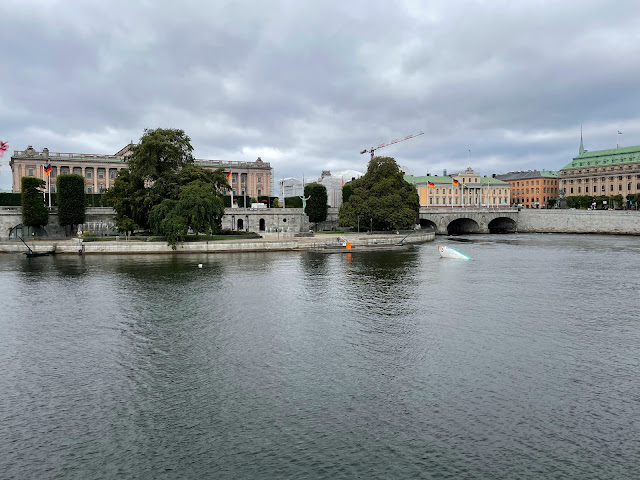
Swedish Parliament building (left) on Helgeandsholmen Island.


Looking back from near the Parliament, this shot is across the bay towards the Grande Hotel.

The Swedish  Royal Palace.


The famed Vasa.

The ship and many of its refurbished curiosities are
displayed inside the Vasa Museum.

A scale model of the ship sitting next to the real
thing.

Stortorget Square in Gamla Stan (old town). 


Changing of the guard at the Palace.


Gym and Mrs. Gym loved this Italian Restaurant 
in the old town. Michelangelos - a real Italian experience!


How narrow were some streets in Old Town?


After a brisk walk in the morning, our hero's
enjoyed a caffeinated beverage with brunch. 
After brunch, they explored one of the many nice green spaces in the city.

Vasaparken

King Karl XIII in Kungstradgarden


Kungstradgarden


Kungstradgarden


Thursday, 16 September 2021

Finding Finland - September 5-6, 2021

Gym was always intrigued by a country that would give its sons names like Teemu Selane, Mikka Kiprusoff and Saku Koivu. As a hockey fan, Gym had been introduced to many great players like these and wondered if when naming a child in Finland, you went with words no one used before, containing the maximum number of vowels.

Speaking of vowels, how did Finland manage to develop its own, very complex language? For centuries, Finland was controlled by Swedish kings and then after the Napoleonic Wars, it came under control of the Russian czars. Finland has really only been truly independent since 1917. And yet, 95% of the population speaks Finnish as a first language and Finnish has no relation whatsoever to Swedish or Russian. Get this, Finnish has no prepositions! And even stranger, the language is most related to Estonian and Hungarian. Apparently, there is only one word used throughout the world from the Finnish language, sauna.

The Marina made two, one-day stops in Finland, one in Kotka, followed by a day in Helsinki.

Kotka

The MS Marina was originally supposed to go to St. Petersburg, Russia. The Russians however, aren't very reliable when it comes to providing comfort that the pandemic is being well-handled and that the people are getting vaccinated. As a result, visiting the fabled capital of the czars would have to wait for another trip. Kotka was one of the two stops that replaced two days in Russia. Kotka was surprisingly, very worthwhile.

Kotka is built on an island, located on the delta formed by the Kymi River, where it flows into the Gulf of Finland. You can drive east to the Russian border, on an excellent highway, in 48 minutes. Alternatively, by driving west you can reach Helsinki in about 90 minutes. We boarded a tour bus at the pier and needed to get on the main highway to reach the city. The main highway was the No. 7, the "Trans-Finland" and it looked like the Trans-Canada, except nicer. This gave Gym an idea. Next time Gym and his lovely companion will drive to St. Petersburg!

Kotka was established in 1878 when the Russians were in control. Before that, the area was the site of more than one large naval battle between Russia and Sweden. Our adventurers learned that you could have set up bleachers on the shoreline of modern Kotka, to watch a doozy of a battle that was fought just offshore in 1789. Today, there is no shortage of cannons and cannonballs being dredged up by archeological people from that battle.

The city itself is clean and well laid out. The brief visit started by checking out the impressive neo gothic, Kotka Church. Constructed in 1898 and renovated in 1999, it is notable for its flying buttresses, its stained glass windows, its pipe organ and the bright wooden interior. There are several pristine 'Urban National Parks' in town, the tour went on to visit one called the Kotka Water Park. Even at this late stage of summer there was still lots of color around the salt water bay that is the nucleus of the park. The park also features a salt-water waterfall. Gym and his boss, took a short walk along the well kept trails. Finally, the tour visited the new Kotka Maritime Museum in town. There are many great exhibits there including a film recreating the naval battle in 1789. As the following pictures show, this museum is a must-see attraction on any visit to the area.


Front door of the Church of Kotka. Neo classical in style,
the building opened in 1898 and was completely renovated
on its centennial. 

Unlike other churches it is light, bright and
spacious.

Above the alter at the front is a huge painting
of The Three Kings.

Beautiful chandeliers and a 44-voice pipe organ are seen 
here in a picture taken of the back of the church.

These massive flying buttresses create the skeleton that 
allow for 3 sets of soaring arches. The church has room for 1500 people.

A water feature at the Sapokka Water Garden.

Sapokka is a salt water bay with a variety of colourful plantings. 


beyond the bridge is the harbour and the Balticc Sea

Boats just beyond the park

A manmade saltwater waterfall...and a poser on the right

A view of the entrance to the Kotka Maritime Museum.

It is built to look like a giant wave.

Finnish Antique Boat Hall from above. 


Until recently the Finns were renowned glass makers in the Kotka area

The Finn's are proud of the icebreakers they build.

A massive wood naval patrol boat - circa WW2.

In Alan Jackson's song, "you can't beat the way an old wood boat rides"
and his daddy's boat even had a  75 Johnson motor like this one.

A car/sleigh/boat is good on land, water and ice.

Helsinki

The MS Marina left Kotka on the evening of September 5, 2021 and sailed west to the capital.  Gym and Mrs. Gym were signed up for a walking tour of the capital, on September 6th. It would cover a lot of ground and Helsinki is hilly!

Helsinki was founded in 1550 but it was during the time when Russia was in charge that it was made the capital and then it really started to grow. Today it has 1.3 million inhabitants. They are spread out over 300 islands that have 11,000 boat berths. 

The capital of Finland is the northernmost country capital city in the world. A little north of 60 degrees latitude, it is also the closest capital city to Santa Claus. Being closer to Santa means you do get a long and cold winter season. The area gets 100+ annual days of snow and an average of 169 annual days with an average temperature below freezing. 

Gym thinks Finland is the cleanest country he has ever visited and Helsinki is the capital of spotlessness. There were no street people in evidence and there was no litter anywhere.  Public spaces were numerous, with wide, green boulevards and lots of well-treed parks. As you will see in the pictures that follow, there is lots of attractive architecture and some amazing public art. How do Finns handle all those short and cold winter days though? Gym thinks that when they are not playing hockey and indoor soccer, they sit at home drinking Finlandia Vodka and come up with new vowel-laden names for their children. In the summer though, it looks to me like theyc an really enjoy the outdoors in such a firsttt class city.

As this is being written after Gym and his dear wife have finished their cruise and left the MS Marina, a brief comment on how that boat ride went.  Generally speaking,  their experience cruising the Baltic Sea was a treat, especially since the boss tends to get seasick. Mrs. Gym commented that the Baltic was like a big bathtub and it was a very smooth 10-day sail. 


Helsinki Cathedral from Senate Square.

Senate Square's central monument, a statue of Czar Alexander II.


Not far from Senate Square is the start of The Esplanade.
This picture looks back toward the Havis Amanda bronze.


Restaurant on Kapelli Esplanade.

The esplanade is still very green in early September.


Helsinki City Hall

Central Railway/Subway Station

Prime Minister's Office from Senate Square

Statue of John Ludvig Runeberg, the Finnish Poet.

Outside the Helsinki Central Train Station the "Lantern Carriers"
wear masks during Covid times. 

In the Central Train Station is the most unique Burger King in the world.
Sure, Burger King could put a store in the train station but they 
couldn't mess with the beautiful interior that was already there

On the inside of the famous Burger King there is a priceless mural
above the wall menus. 

The Temppeliakio Church from the outside looks like a bunker.
It is built right into solid rock.

Inside Temppeliakio Church you see the solid rock walls and 
the copper domed ceiling. Really cool!

Sibelius Monument located in Sibelius Park.
Sibelius was Finland's greatest composer. Dedicated
in 1967 by Finn sculptor Eila Hiltunen.

A bust of the composer sits next to the monument.

Leaving Finland


Curious About Curacao

Curaçao - March 20-30, 2026 A pair of Curaçao flamingoes A nice sunset from the beach at the Curaçao Marriott Beach Resort  Who knew that Cu...